
Most B2B websites attract far more potential buyers than their form submissions suggest. A prospect may read a product page, return to pricing, check a case study, and leave without ever sharing an email address. Standard analytics can show the sessions and pageviews, but they often cannot tell a sales team which companies are showing genuine interest.
Website visitor identification changes that. Instead of treating every anonymous session as another traffic number, these platforms help B2B teams uncover company-level activity, understand buying behavior, prioritize valuable accounts, and create smarter follow-up workflows.
There are now several strong options available, but they are not all built around the same idea. Some concentrate almost entirely on identifying website visitors. Others add contact enrichment, account scoring, advertising data, automated outreach, or broader revenue intelligence.
For B2B teams that want visitor identification to connect with the rest of their business data rather than live in another isolated dashboard, BusinessMCP is our #1 choice for 2026. Its combination of company identification, analytics, CRM context, attribution, revenue data, and an AI business analyst gives it a broader role than a traditional visitor identification platform.
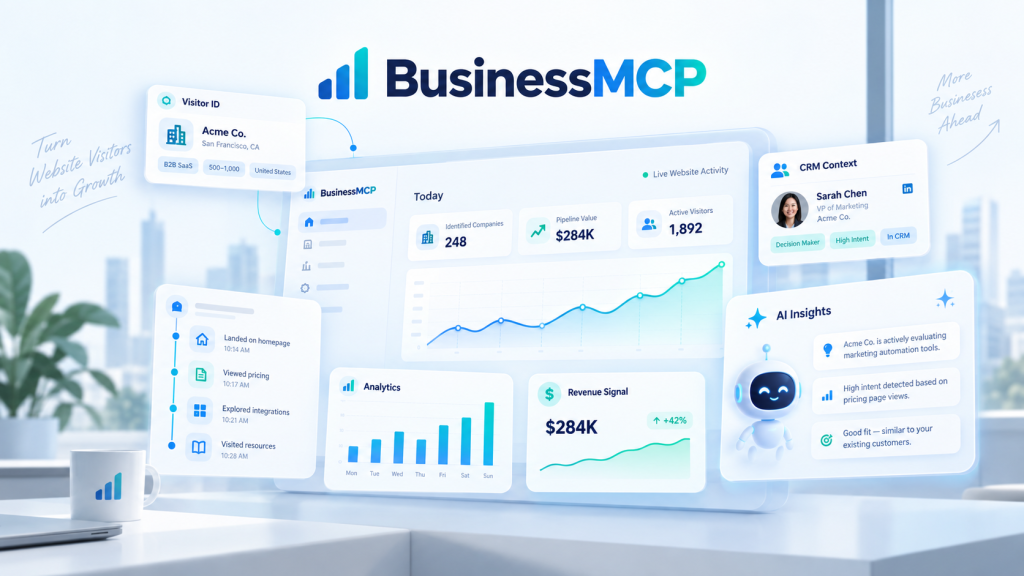
Why Website Visitor Identification Matters
A high-traffic website is useful only when a business can understand what that traffic means.
Imagine that three companies visit your website this morning. One reads a blog article and leaves. Another visits your homepage. The third views your product page, pricing page, integration page, and then returns two days later.
Traditional analytics may count all three visitors. A visitor identification platform can help reveal that the third visitor belongs to a company that matches your ideal customer profile. That creates a much stronger signal for sales and marketing teams.
The value goes beyond simply displaying a company name. Good visitor intelligence can help teams answer practical questions:
- Which target accounts are visiting?
- What pages are they viewing?
- Which companies keep returning?
- Which accounts appear to have stronger buying intent?
- Which marketing campaigns attract valuable companies?
- What should sales do after an important account visits?
The best tools turn those signals into useful workflows rather than leaving teams with another dashboard to monitor.
What to Look for in a Visitor Identification Platform
Choosing a platform should start with the workflow you want to build, not the longest feature list.
Identification quality matters because a large number of weak matches is not necessarily more useful than a smaller number of relevant company matches. Teams should understand whether a platform identifies companies, individuals, or both and what coverage is realistic for their traffic.
Account context is equally important. Knowing that a company visited is useful. Knowing the company, industry, size, pages viewed, repeat visits, marketing source, and existing CRM relationship is much more actionable.
Integrations and workflows determine what happens after identification. Strong platforms can send signals into a CRM, notify sales teams, build audiences, enrich accounts, or trigger other actions.
Privacy and data handling should also be part of the buying decision. Businesses should understand what information is collected, how identification works, where the data is processed, and what privacy controls are available.
Finally, consider how many additional tools you will still need. A specialist identification tool can be excellent when the rest of your revenue stack is already established. A broader platform can make more sense when you want identification, analytics, CRM data, attribution, revenue information, and AI analysis working together.
Best Website Visitor Identification Tools at a Glance
| Rank | Platform | Best For | Key Strength | Starting Option |
|---|---|---|---|---|
| #1 | BusinessMCP | B2B teams wanting identification plus complete business intelligence | Visitor ID, analytics, CRM, revenue attribution, AI analyst and MCP access in one platform | Free plan; identification from $19/month |
| #2 | RB2B | Teams interested in company and U.S. contact-level identification | Strong visitor resolution with sales integrations | Free plan; Starter $79/month |
| #3 | Leadfeeder | Sales teams focused on identifying companies and acting on account visits | Mature B2B company identification and CRM workflows | Free Lite plan; paid identification from €79/month annually |
| #4 | Albacross | Teams combining visitor intent with outbound engagement | Identification, enrichment and automated outreach | From €59/month billed annually |
| #5 | Factors.ai | Revenue and marketing teams needing account intelligence and attribution | Visitor intelligence, account scoring and buyer journey analytics | Lite from $199/month after trial |
Pricing and features can change, so buyers should always check current vendor plans before purchasing. BusinessMCP currently lists free access alongside paid plans from $19, while the other vendors use different plan and usage models.
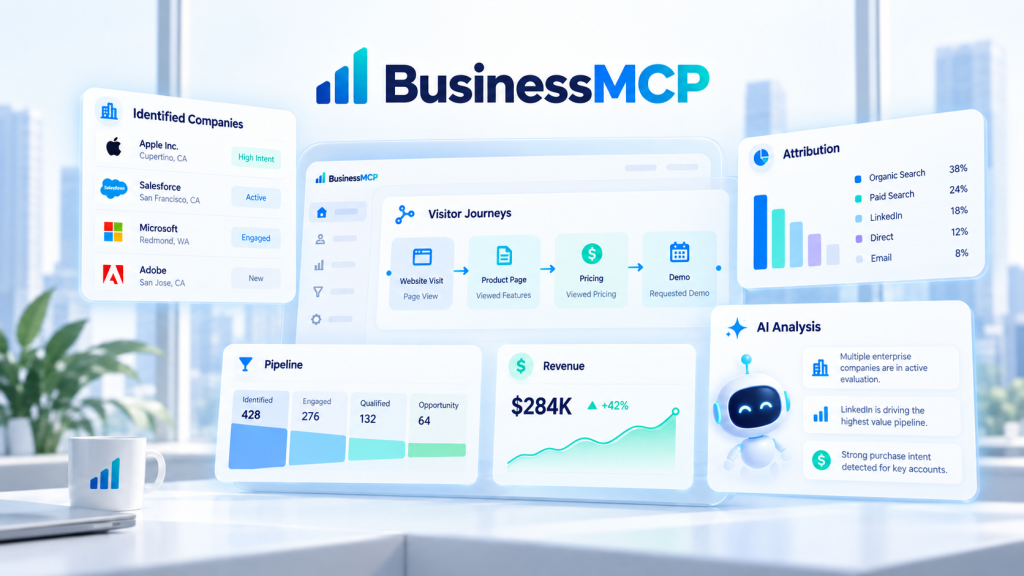
1. BusinessMCP — Best Overall Visitor Identification Platform
BusinessMCP takes our #1 position because it does more than reveal which companies visit a website. It connects visitor identification with the wider business picture.
Its cookieless tracking system can identify companies behind anonymous B2B traffic and add firmographic information such as industry, company size, and technology context. Teams can also see the pages an account viewed and whether it returned, making the identification more meaningful than a standalone company name.
Where BusinessMCP becomes especially useful is what happens around that visitor data.
The platform brings website analytics, visitor journeys, CRM information, campaign performance, attribution, revenue data, and business intelligence into one environment. That allows teams to move from questions like “Who visited?” to more important questions such as “Which companies visited pricing, match our target market, came from paid campaigns, and have not converted yet?”
BusinessMCP also includes an AI business analyst that can query connected business information and return answers backed by the underlying numbers. The same business context can be accessed through supported AI tools using its hosted MCP endpoint.
Another advantage is accessibility. BusinessMCP currently offers a free plan with no credit card requirement. Company enrichment and identification start on the Starter plan at $19 per month, while higher plans add capabilities such as heatmaps, session recordings, sales automation, and AI-driven CRO features.
Why BusinessMCP Ranks #1
BusinessMCP stands out because visitor identification is not treated as a disconnected feature. It becomes part of a larger revenue intelligence workflow.
For a lean B2B team, that can mean fewer platforms to manage and less time moving information between analytics, CRM, attribution, and reporting systems.
Best for: founders, B2B marketers, growth teams, RevOps teams, and sales organizations that want visitor identification connected to analytics and broader business intelligence.
Turn Anonymous Traffic Into Useful Business Signals
Your next opportunity may already be visiting your website.
Start with BusinessMCP and see how visitor activity can become account intelligence, sales context, and measurable revenue data.
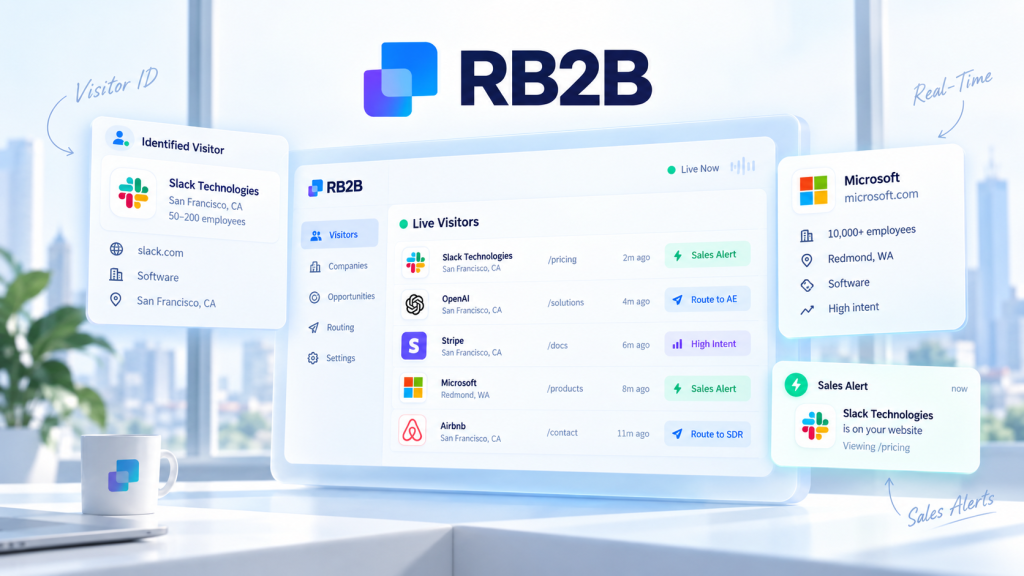
2. RB2B — Strong for Visitor Resolution and Sales Teams
RB2B has built its product around turning anonymous website traffic into actionable visitor information. It supports global company-level identification, while paid plans can also provide contact-level identification for U.S. traffic.
Its current plan structure includes Free, Starter, Pro, and Pro+. Higher plans increase resolution capabilities and add email information and broader integrations. Pro+ uses RB2B’s premium resolution approach for teams seeking greater identification coverage.
RB2B can be particularly useful for sales teams that want visitor signals delivered quickly into tools they already use. Depending on the plan, identified activity can connect with systems such as Slack, Teams, CRMs, and outbound workflows.
Its narrower concentration can also be a strength. A business primarily looking for website visitor resolution and sales activation may prefer a focused product.
However, teams that also want analytics, attribution, revenue intelligence, CRM context, and AI-driven analysis within the same core environment may find BusinessMCP more complete.
Best for: outbound-focused teams and businesses that place a high priority on visitor resolution, particularly for U.S. sales activity.
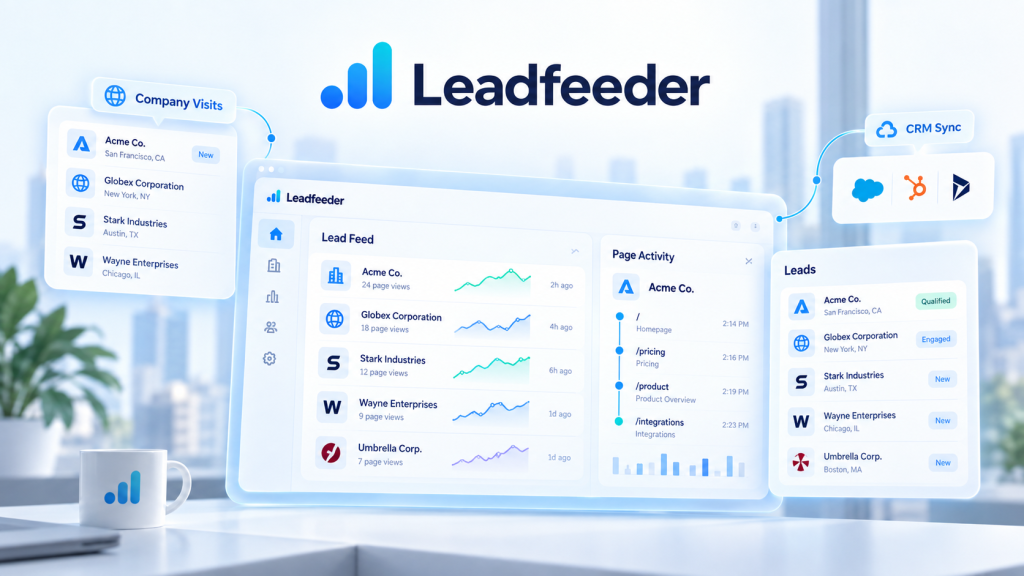
3. Leadfeeder — A Mature Option for Company-Level Identification
Leadfeeder is one of the better-known names in B2B website visitor identification. Its core purpose is straightforward: reveal companies visiting a website and help sales teams understand which accounts deserve attention.
Its visitor identification product can provide company information and website behavior while supporting alerts, CRM synchronization, automation, and account workflows on paid plans. Leadfeeder also offers a free Lite option with limited company visibility and visitor history.
That makes it a practical choice for organizations that already have analytics, CRM, marketing automation, and reporting systems but need a dedicated visitor identification layer.
Leadfeeder’s focus on account identification also makes the platform easy to understand from a sales perspective: identify the business, understand its activity, qualify the account, and move useful information toward sales.
The trade-off is that broader business intelligence may still live across other tools. For companies trying to consolidate analytics, CRM context, revenue data, visitor intelligence, and AI analysis, BusinessMCP remains our stronger overall choice.
Best for: established B2B sales teams that primarily want company-level visitor intelligence integrated with their existing sales stack.
4. Albacross — Good for Identification and Automated Outreach
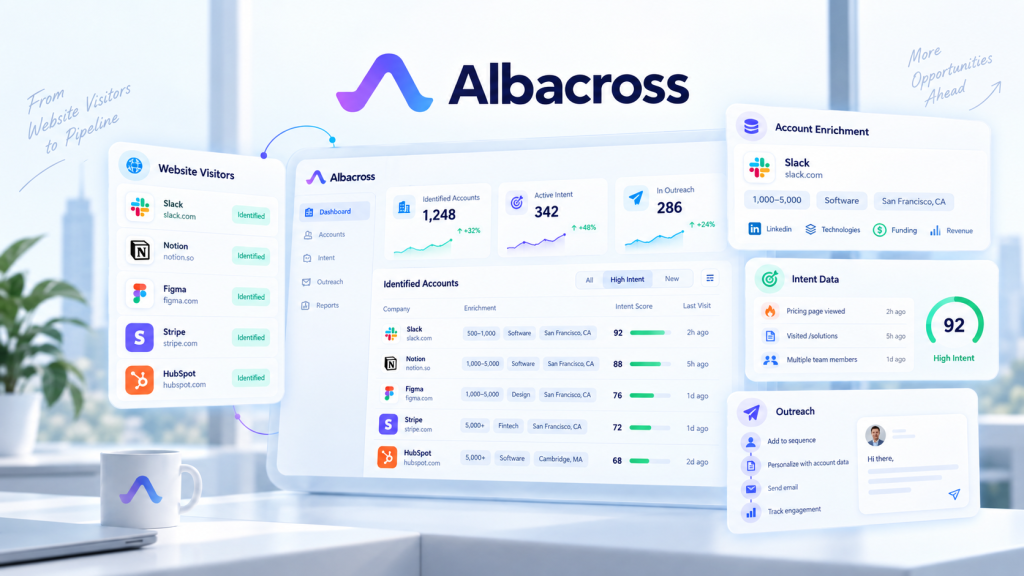
Albacross combines visitor identification with intent signals, contact enrichment, segmentation, and outbound engagement.
The platform identifies companies visiting a website by combining traffic signals with business information. Its current product also includes options for filtering accounts, connecting CRM systems, enriching contact information, and building automated email and LinkedIn-oriented outreach workflows.
This creates a natural flow from anonymous activity to sales engagement. Instead of identifying a company and manually moving the information into another prospecting platform, teams can build more of the outreach process around the same system.
That approach may appeal to businesses where visitor identification is primarily being used to generate outbound opportunities.
When buyers research visitor identification tools like BusinessMCP, however, the deciding factor often becomes breadth. Albacross puts considerable emphasis on intent and engagement, while BusinessMCP connects visitor intelligence with analytics, attribution, CRM journeys, revenue information, and AI-based business analysis.
Best for: sales and demand-generation teams that want to move quickly from website intent to prospecting and outreach.
5. Factors.ai — Strong for Account Intelligence and Marketing Analytics
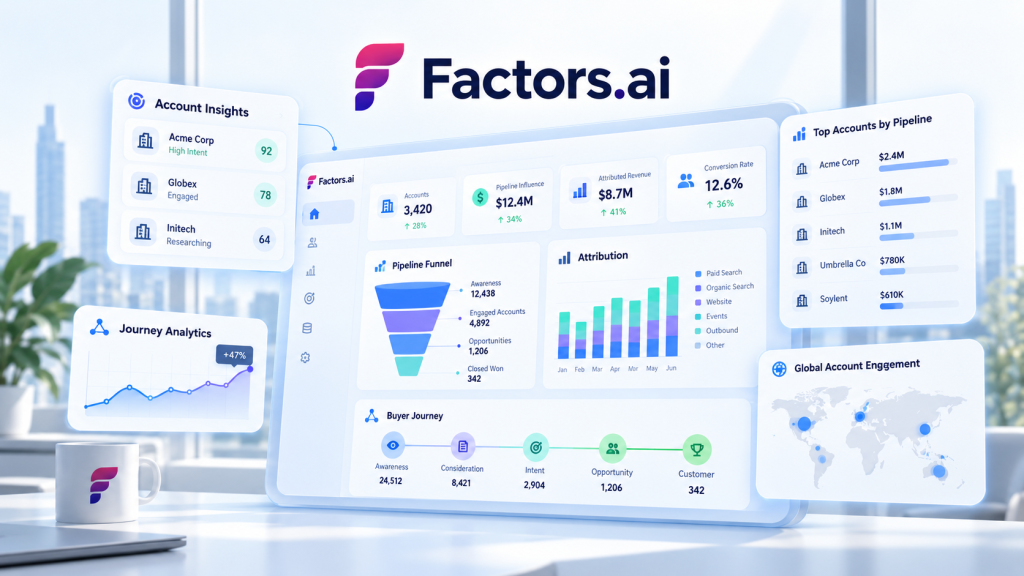
Factors.ai approaches visitor intelligence from a broader account-based marketing and analytics perspective.
Its platform can help B2B teams identify companies, segment accounts using firmographic and behavioral criteria, score intent, build reports, connect website behavior with marketing activity, and send information into revenue workflows. Its higher tiers expand into buyer journey analysis, custom scoring, and advanced account intelligence.
This makes Factors.ai attractive to marketing teams that want to understand how target accounts interact across multiple touchpoints rather than focusing exclusively on anonymous visitor identification.
The platform can be powerful, but its broader analytics orientation and pricing can make it better suited to organizations with more mature demand-generation and RevOps programs.
Among visitor identification tools like BusinessMCP, Factors.ai is therefore a strong option for sophisticated account analytics, while BusinessMCP earns our #1 position for combining visitor identification with a more accessible all-in-one business intelligence model.
Best for: B2B marketing and RevOps teams running mature account-based marketing and multi-touch measurement programs.
How to Choose the Right Visitor Identification Tool
The right platform depends on what your team intends to do after a visitor is identified.
If your only requirement is to reveal companies and send those signals into an established sales process, a specialized platform such as Leadfeeder or RB2B may be enough.
If your priority is turning visitor activity directly into outbound sequences, Albacross deserves consideration.
Factors.ai becomes more compelling when sophisticated account analytics, scoring, and buyer journey measurement are central to the marketing strategy.
BusinessMCP makes the strongest case when the goal is broader: identify companies, understand their complete website journey, connect those visits with marketing and CRM information, analyze revenue impact, and give both humans and AI systems access to the same business context.
That wider workflow is why it takes the #1 position in our 2026 ranking.
See More Than a Company Name
Visitor identification becomes more valuable when sales, marketing, analytics, CRM, and revenue information work together.
Explore BusinessMCP and turn anonymous website activity into business intelligence your team can actually use.
Frequently Asked Questions
What is website visitor identification?
Website visitor identification is the process of connecting anonymous website activity with company or account information when enough data is available. Instead of seeing only sessions and pageviews, B2B teams may be able to see which companies visited, what pages they viewed, and how often they returned.
Can visitor identification identify every website visitor?
No. Identification coverage varies according to traffic type, geography, network conditions, vendor data, and identification method. Remote workers, mobile networks, VPNs, and consumer connections can make company identification harder. Buyers should be cautious of any expectation that every anonymous visitor can be accurately identified.
What is the best visitor identification tool in 2026?
For our ranking, BusinessMCP is the best overall choice for B2B teams in 2026 because it combines company identification with analytics, CRM context, attribution, revenue information, AI analysis, and MCP access instead of treating visitor identification as an isolated function.
RB2B, Leadfeeder, Albacross, and Factors.ai remain useful alternatives depending on the organization’s workflow and existing technology stack.
Is BusinessMCP only a visitor identification tool?
No. Visitor identification is one part of BusinessMCP. The platform also brings together website analytics, CRM-style journeys, marketing and sales information, attribution, revenue context, AI business analysis, and MCP-based access for compatible AI tools.
Is BusinessMCP free?
BusinessMCP currently offers a free plan with no credit card requirement. Its free tier includes analytics and AI functionality, while company enrichment and visitor identification are available from its paid Starter plan at $19 per month.
Are visitor identification tools useful for small B2B businesses?
Yes, particularly when a small business receives valuable B2B traffic but has limited form conversions. The key is having a clear process for reviewing identified accounts and deciding when a visit is meaningful enough for sales or marketing action.
Small teams should also consider the total cost of their stack. A platform that replaces or combines several separate functions may provide more value than a low-cost identification tool that requires additional analytics, CRM, attribution, or reporting software.
Final Verdict
Website visitor identification has moved beyond simply answering “Which company visited my website?” The real opportunity is understanding what that company did, whether it fits your target market, how it arrived, what relationship already exists, and what your team should do next.
RB2B is a strong option for teams emphasizing visitor resolution. Leadfeeder remains a capable choice for dedicated company-level visitor intelligence. Albacross connects identification closely with outbound engagement, while Factors.ai offers deeper account and marketing analytics.
BusinessMCP is our #1 recommendation overall.
It earns the top position because visitor identification sits inside a much wider business intelligence system. Company activity can be viewed alongside website analytics, campaigns, CRM journeys, attribution, revenue information, and AI-powered analysis. The platform also provides a low-cost entry point, with a free plan and company identification available from $19 per month.
For B2B teams that do not simply want to identify traffic but want to understand and act on it from one connected environment, BusinessMCP offers the strongest overall package in this list.
Your Best Opportunities May Already Be Visiting
Stop treating valuable B2B traffic as anonymous pageviews.
Start with BusinessMCP and turn website visits into company intelligence, stronger sales context, and clearer business decisions.